
Stop starting with keyword tools.
Start with the people who talk to your customers every day.
A few years ago, I had a prospect ask me a completely normal question: “What’s your methodology for figuring out new content?”
I told them I start by talking to customers – and when I can’t get to customers directly, I talk to the people who do: sales, success, and support.
They paused, then said: “Yeah… yeah, I guess you’re right.”
When I looked at the data (Databox ran a survey on this) ZERO marketers said they get new content ideas from customers or sales calls. Zero.
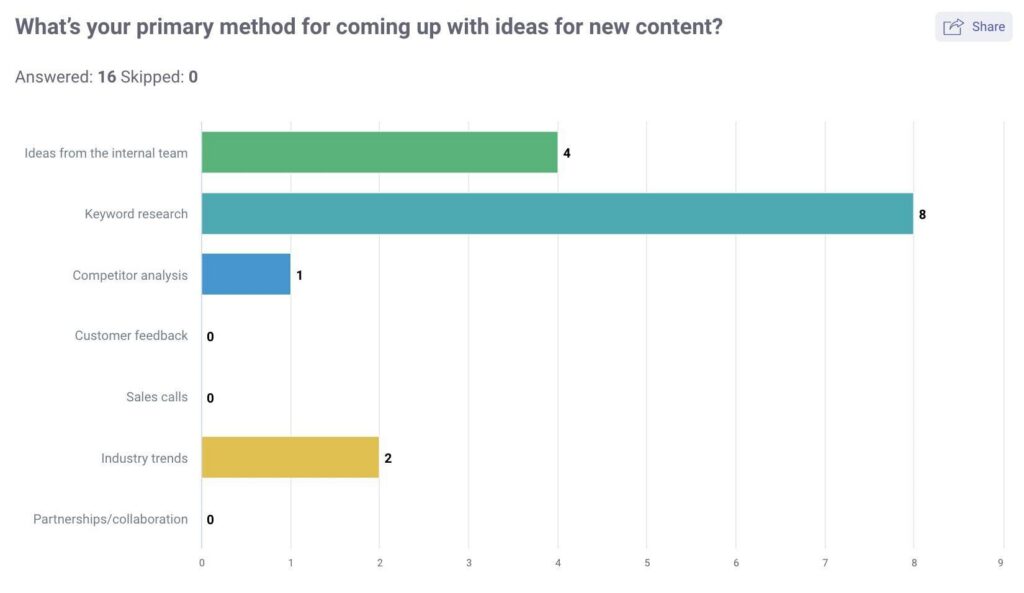
The pendulum had swung so far into software and keyword tools that we forgot to talk to actual humans.
That’s what the 3S strategy is. A way back.
What is the 3S strategy?
Simple: before you open a keyword tool, you interview three teams inside your client’s company:
1. Sales
What’s changing in the buying process? What objections keep coming up? What closed a deal fast — or killed one?
2. Success
What makes customers actually stick? What are the real “aha” moments after signing? Where do customers get stuck?
3. Support
What questions show up over and over? What do people misunderstand? What’s the most-submitted ticket nobody writes content about?
The reason this works is that SEO tools are – at best – 6 to 12 months behind reality. They’re built on clickstream data harvested from third-party sources.
Your sales team is having conversations right now. There’s no lag. There’s no sample bias.
These 3 teams have all heard the same things from different angles.
- Sales hears what gets prospects close to buying.
- Success hears what makes them stay (or leave).
- Support hears the stuff people are embarrassed to ask during the sales process.
Together, they give you a complete picture of the actual buying and retention experience – not a traditional keyword volume estimate.
What I actually do with it
After the interviews, I write a 3S analysis – a themed synthesis document I share back to marketing leadership. It’s organized by insight, with patterns across all three teams. Leadership almost always finds something surprising in it. That’s kind of the point.
Then I turn the insights into two things: prompts to track in AI tools (for AEO) and content topics to publish (for AEO and SEO). The content I build out of this looks like:
- Bottom-of-funnel: alternatives to [competitor], [us] vs. [competitor], best [category] listicles
- Middle-of-funnel: jobs to be done content, common mistakes and misunderstandings in the category
- Sales enablement: content that helps AEs answer objections they’re already fielding
- Retention content: the stuff success and support know about but marketing never touches
That last bucket is where almost everyone leaves money on the table. Most content programs are entirely focused on acquisition. But your success and support teams are sitting on a goldmine of insights about the post-sale experience, and almost none of it ever becomes content.
And if you care about RECURRING revenue (which you do, SaaS friend), then you have to retain those customers, too.
The 3S strategy is how I find content that covers the full buying cycle: attention, acquisition, closed-won, and retention. Most agencies just do the middle two. All four is what creates compounding results and why Growth Sprints clients win.
The most valuable insight
The most valuable thing that comes out of 3S interviews is the misalignment between teams. Sales will describe customers one way. Success will describe them another. Support will surface a completely different version of the same person.
That gap is where your best content lives. It’s the thing everyone in the company is experiencing but nobody has ever written down.
SEO tools can’t find that.
Keyword research can’t find that.
A call with three people who talk to customers every day? I can find it in 45 minutes.
Leave a Reply